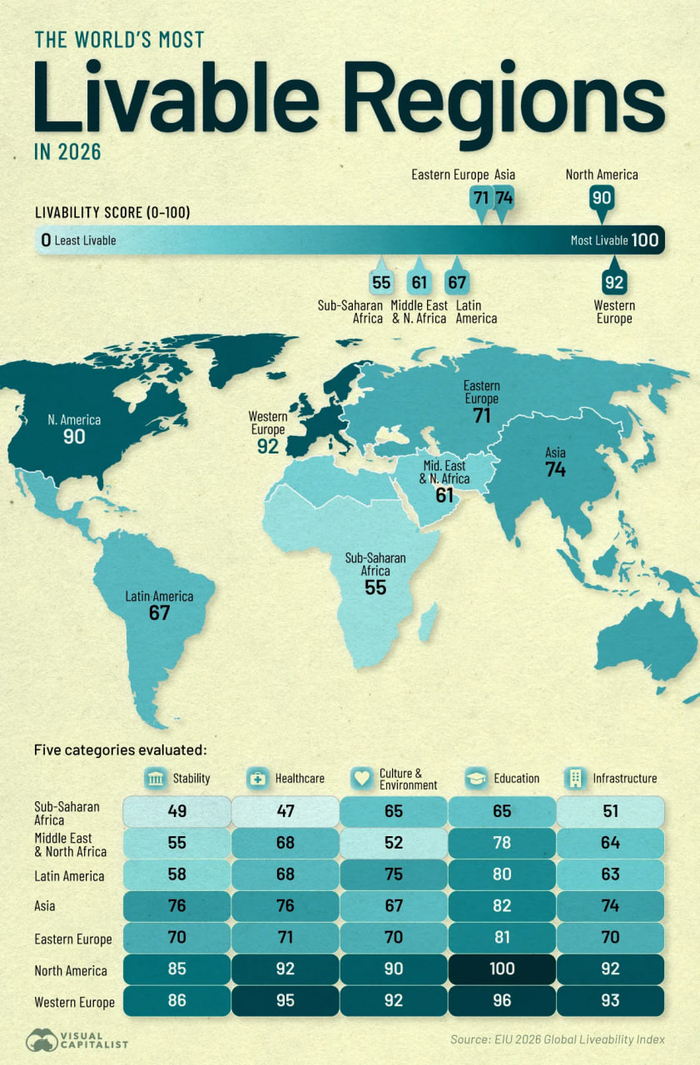
The Economist Intelligence Unit (EIU) has published its annual Global Quality of Life Index, which assesses living conditions in the world’s largest cities. The study compares average scores across seven regions, highlighting differences in living standards in 2026. This was reported by Dengi.ua, citing an infographic by Visual Capitalist.
In compiling the ranking, experts considered five key criteria: stability, healthcare, culture and the environment, education, and infrastructure. The final scores were calculated on a scale from 0 to 100 points.
Western Europe topped the 2026 ranking with a score of 92 points. North America took second place with a score of 90 points. Both regions received high marks thanks to the quality of their healthcare services, educational systems, and well-developed infrastructure. North America scored the maximum 100 points for education, while Western Europe ranked highest in healthcare and infrastructure.
The high standard of living in the cities of these regions is ensured by stable government institutions, efficient public services, and a well-developed transportation network.
Asia demonstrated the most notable progress over the past year. The average quality-of-life score there rose to 74 points, marking the best performance in terms of growth among all regions. The EIU notes that this improvement was driven by higher ratings for cities in China and Japan. Nevertheless, the region still lags behind the leaders in the ranking: Asia received its weakest scores in the “culture and environment” category, and the level of infrastructure development varies significantly from country to country.
The most significant decline in performance in 2026 was recorded in the Middle East and North Africa. Following the war with Iran, the average regional score dropped by one point to 61. Stability remains the most problematic category for the region, which negatively affects the final score.
Sub-Saharan Africa ranked last, with an average score of 55 points. The lowest scores in this region were in the areas of healthcare, infrastructure, and stability.
Latin America and Eastern Europe were positioned in the middle of the ranking. Both regions demonstrated relatively high scores in education, but lower scores on the stability criterion prevented them from improving their overall results.