The level of trust in Ukrainian President Volodymyr Zelenskyy has declined slightly compared to the spring, but the majority of Ukrainians still support the head of state and oppose holding national elections until the war ends. This is evidenced by the results of a KIIS poll conducted from July 20 to August 3, 2026, as reported by Dengi.ua.
The survey included 974 adult respondents residing in territory controlled by Ukraine. The survey was conducted via telephone interviews.
Trust in Zelenskyy Remains Higher Than Distrust
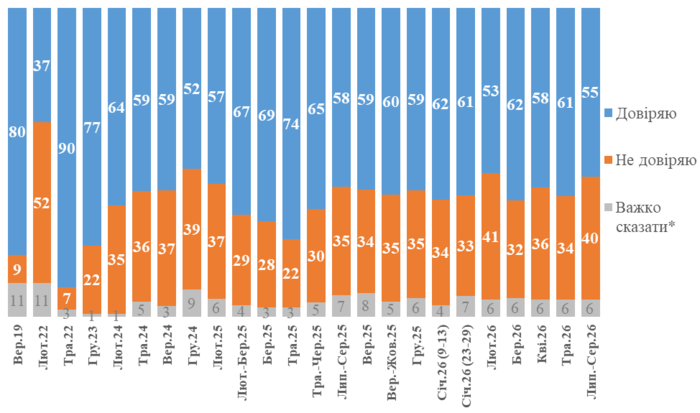
According to the survey results, 55% of Ukrainians trust Volodymyr Zelenskyy, while 40% expressed distrust. Thus, the trust balance stands at +15 percentage points.
Compared to April, the figures have deteriorated slightly. At that time, 58% of respondents trusted the president, while 36% did not, corresponding to a balance of +22 percentage points.
The Kyiv International Institute of Sociology (KIIS) notes that the decline in trust occurred following high-profile personnel decisions by the government and public protests. At the same time, sociologists emphasize that there is no question of a collapse in his approval rating.
Among those who trust the president, 20% trust him completely, and 34% tend to trust him. Among critical citizens, 19% do not trust the head of state at all, and another 21% tend not to trust him.
Most Ukrainians do not Support Holding Elections During the War
The survey also showed that Ukrainians remain unwilling to hold national elections until hostilities have ended.
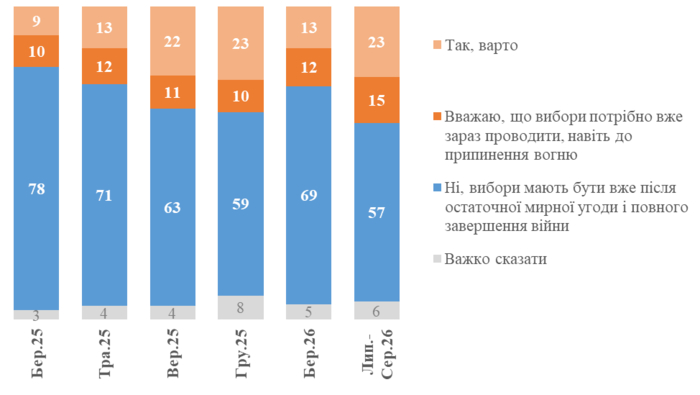
Specifically, 57% of respondents believe that elections should take place only after a final peace agreement is signed and the war ends.
Another 23% are willing to support holding elections after a ceasefire, provided there are reliable international security guarantees.
Only 15% believe that voting should take place right now, even before hostilities cease.
Compared to March, the number of people in favor of holding elections after a ceasefire has increased — from 13% to 23%. At the same time, the share of those who support holding elections only after the war ends has decreased from 69% to 57%, though this position remains the prevailing one.
Even Among Zelenskyy’s Critics, there is no Majority in Favor of Immediate Elections
Pollsters separately analyzed attitudes toward elections based on the level of trust in the president.
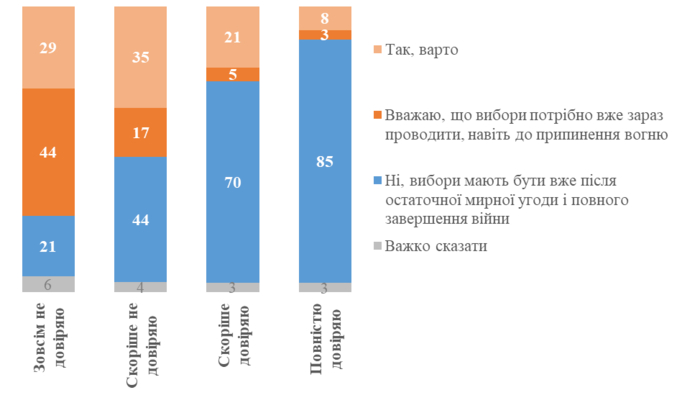
Among those who completely distrust Zelenskyy, only 44% support holding elections before the war ends. Another 29% believe voting is possible after a ceasefire and the receipt of security guarantees, while 21% support elections only after a final peace agreement.
Among citizens who tend not to trust the president, only 17% support holding elections during the war. The majority, however, prefer to wait for either a ceasefire or the complete end of the war.
The overwhelming majority of Ukrainians who trust Volodymyr Zelenskyy also believe that elections should take place only after the war ends.
Which Elections do Ukrainians Consider a Priority?
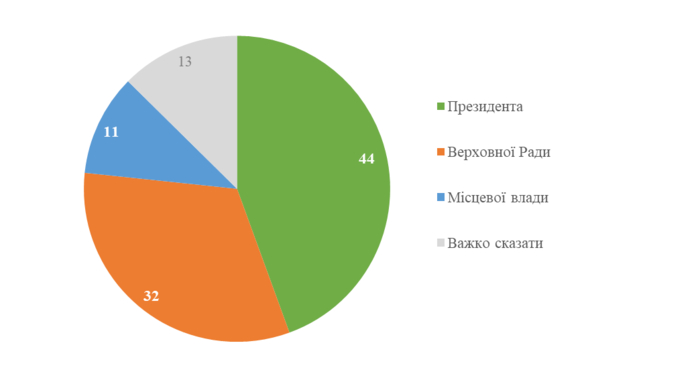
If holding elections becomes possible, 44% of respondents believe that the President of Ukraine should be elected first.
Another 32% favor holding parliamentary elections first, while 11% consider local government elections a priority.
What Sociologists Are Saying
Anton Grushetsky, Executive Director of the Kyiv International Institute of Sociology (KIIS), noted that the protests and the government’s personnel decisions have indeed influenced public opinion toward the president, but have not led to a sharp drop in trust.
According to him, most Ukrainians continue to view the current government through the lens of the war and the need to maintain state governance until an acceptable peace is achieved. At the same time, many citizens believe that the issue of political accountability should be resolved after the war ends through democratic elections.
KIIS also notes that public sentiment among broad segments of the population often differs from discussions on social media, where reactions to political events are typically much more emotional.
The survey was conducted from July 20 to August 3, 2026, using computer-assisted telephone interviews (CATI) among 974 adult residents of Ukraine in territories controlled by the Ukrainian government. The margin of error for the sample does not exceed 4.1%.