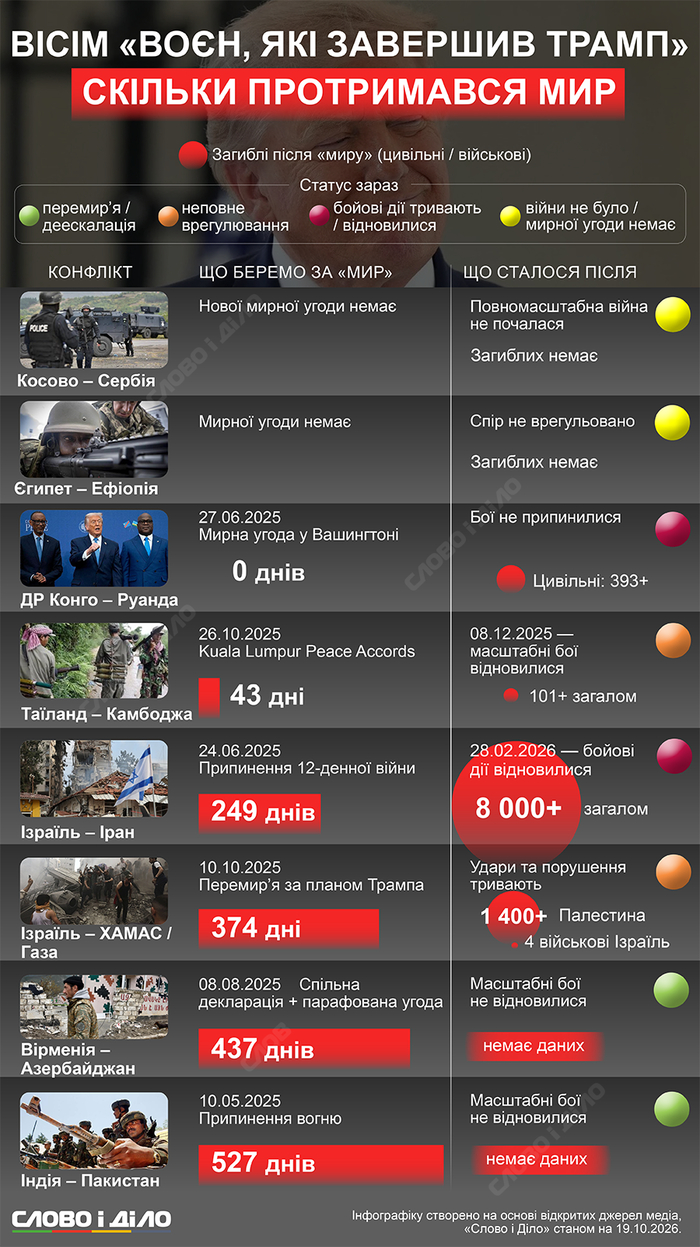
On October 14, 2025, the U.S. State Department posted an image with the caption “President Trump: President of Peace,” listing eight armed conflicts that, according to the U.S. administration, Donald Trump had resolved in eight months. The list included conflicts between Cambodia and Thailand, Kosovo and Serbia, the Democratic Republic of the Congo (DRC) and Rwanda, India and Pakistan, Israel and Iran, Egypt and Ethiopia, Armenia and Azerbaijan, as well as Israel and Hamas. This was reported by Dengi.ua, citing an infographic from “Slovo i Dilo.”
However, an analysis of these cases shows that by no means did all of the claimed achievements lead to an actual cessation of violence. In four situations, the announced peace agreements proved short-lived or failed to bring an end to hostilities. In two other cases, the issues involved diplomatic disputes rather than wars. A sustainable cessation of violence was achieved in only two conflicts, and the extent of Trump’s influence on this outcome remains a matter of debate.
Four Peace Initiatives That Did Not Lead to a Sustainable Cessation of Hostilities
One of the most obvious examples of a failed settlement was the conflict between the Democratic Republic of the Congo and Rwanda. The current phase of the conflict began in March 2022, when Rwandan troops entered the territory of the neighboring country in support of the M23 movement, with which they are allied. The “Congo River Alliance” is also fighting on Rwanda’s side, while the DRC receives support from Burundi and Uganda.
On June 27, 2025, with U.S. mediation, the parties signed a peace agreement. The day before, Donald Trump commented on the agreements reached: “They’ve been fighting for many years, and with machetes—it’s one of the worst, most horrific wars anyone has ever seen. And I was just lucky to have a person who managed to settle everything.”
Trump also stated that, in return for his peacemaking efforts, he received “many mineral extraction rights in the Congo.” However, the agreement did not put an end to the conflict, which has continued in various forms for more than 30 years. Rwandan troops and affiliated armed groups continued their military operations. Even the renewal of the agreement in December 2025 did not lead to a definitive end to the war.
Efforts to bring a lasting end to the clashes between Thailand and Cambodia also failed. The escalation was triggered by a long-standing dispute over the ownership of ancient temple complexes and adjacent border territories. In July 2025, the disagreements escalated into a series of armed clashes. Under pressure from Washington, the parties agreed to a ceasefire; however, just 43 days after the agreements were signed, hostilities resumed, once again resulting in civilian casualties.
The agreements related to the two conflicts in the Middle East also failed to meet expectations. In the case of the Gaza Strip, the agreement did not bring about a definitive end to the confrontation between Israel and Hamas: the Israeli army continued its military operations against the Palestinian movement.
A similar situation has developed regarding the confrontation between Israel and Iran. Despite the announced end of the Twelve-Day War in 2025, in late February 2026, Israel, together with the United States, launched a new military operation against Iran. At the time this article was prepared, hostilities were ongoing, casting doubt on the notion of a final resolution to this conflict.
Two Instances When Trump Declared Peace Without a Preceding War
Two other items on the U.S. administration’s list raise questions for a different reason: there were no full-scale military operations between the mentioned states that could be considered a concluded war.
In June 2025, Trump claimed that he had prevented an armed conflict between Serbia and Kosovo before it even began. According to him, he warned his Serbian partners that the U.S. does not do business with people who intend to start wars.
At the same time, the U.S. president did indeed participate in diplomatic efforts to normalize relations between the parties. In April 2020, with his assistance, an agreement on economic normalization was signed. However, the document did not resolve the fundamental differences between Serbia and Kosovo, and the conflict itself persisted.
In June 2025, Trump announced that he had managed to prevent a potential war between Egypt and Ethiopia. The dispute between the two countries stems from the construction of Ethiopia’s Grand Ethiopian Renaissance Dam (GERD) on the Blue Nile. Addis Ababa insists on its right to use its own water resources to generate electricity, while Cairo fears negative consequences for the country’s water supply.
At the same time, there is no convincing evidence that Egypt and Ethiopia were actually planning to resort to military action. Nevertheless, Trump included the resolution of this dispute in his list of peacemaking achievements, just as he did with Serbia and Kosovo.
Two Conflicts in Which a Ceasefire Was Achieved
In the two other cases cited by the U.S. administration, large-scale hostilities were indeed brought to an end. These were the standoff between India and Pakistan, as well as the long-standing conflict between Armenia and Azerbaijan.
In the spring of 2025, relations between India and Pakistan once again deteriorated sharply due to the situation in Kashmir. Border incidents occur regularly between the two nuclear powers, but this time the clashes were accompanied by an exchange of missile strikes and artillery fire. On May 10, the parties agreed to a ceasefire.
Trump attributes the outcome to his own efforts, claiming that he influenced both countries through economic leverage. The Pakistani side supports this assessment. India, on the other hand, denies that the U.S. president played a decisive role and states that the ceasefire was achieved through direct negotiations between the two countries.
Another example was the normalization of relations between Armenia and Azerbaijan. On August 8, 2025, the leaders of the two countries met with Trump and signed a joint declaration. During the same period, the foreign ministers of Armenia and Azerbaijan concluded an agreement providing for the establishment of peace and the normalization of bilateral relations.
However, the groundwork for this settlement had been laid long before that. In September 2023, Azerbaijan established full control over Nagorno-Karabakh. Over the next two years, the parties held negotiations on humanitarian, transportation, and diplomatic issues, seeking to work out the terms for normalizing relations.
Therefore, the claim that it was Trump who ended the war between Armenia and Azerbaijan does not fully reflect the course of events. The U.S. president played a certain role in the process of formally cementing peace, but the negotiations and changes on the ground began before his involvement.
Thus, of the eight conflicts that the Trump administration presented as having been resolved thanks to the U.S. president, in four cases the peace agreements did not ensure a lasting cessation of hostilities. In two other situations, the focus was on preventing hypothetical wars that never escalated into actual armed conflicts. And only in two cases was it possible to achieve an end to large-scale violence, although the extent of Trump’s personal contribution to these outcomes remains debatable.