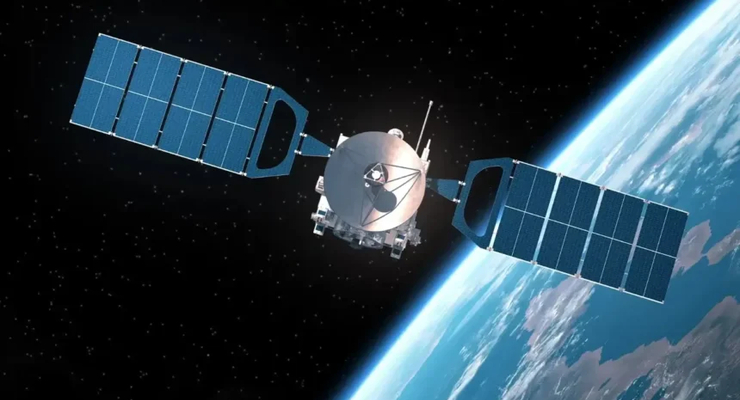
To fully deploy the network and guarantee continuous coverage across the entire country, a constellation of at least 100 satellites will need to be launched into orbit. This strategic project is being developed by an international consortium of private companies under the leadership of Ukraine’s HIMERA and Denmark’s GomSpace to serve the needs of the Armed Forces and government agencies, and its implementation could take one to two years.
This was reported by Misha Rudominsky, co-founder and CEO of HIMERA, in an interview with the industry publication “Oboronka”, as cited by Dengi.ua.
Technical Specifications and Capabilities of the OBRIA Network
The creation of Ukraine’s own orbital network is intended to drastically reduce the country’s dependence on foreign satellite communication providers and expand the capabilities of existing European systems. A Ukrainian national operator will be fully responsible for managing the constellation.
Key parameters of the future space infrastructure:
- scale and dimensions: to ensure a basic, uninterrupted signal over Ukraine, at least 100 production-model satellites weighing approximately 250 kg each must be deployed;
- intended purpose: the network is designed primarily to provide secure and reliable communications for units of the Armed Forces of Ukraine, as well as for government and state institutions;
- speed and stability: the system’s architecture supports high-speed data transmission, streaming video with minimal latency, and the operation of user terminals on moving vehicles;
- current testing phase: on October 1, 2026, as part of the SpaceX Transporter-18 mission, a 10-kilogram OBRIA NANO test unit was successfully launched into orbit to validate core technologies.
Funding for the Space Program and Localization of Production
According to the developers’ estimates, logistical, technological, and operational risks could affect the final deployment timeline; however, under a favorable scenario, the network will become operational within 1–2 years. In the future, the consortium intends to move the assembly of production-run satellites and the manufacturing of ground terminals directly to Ukraine.
Financial aspects of the space initiative:
- private capital: the first phase of development and the launch of a test nanosatellite were funded exclusively by consortium members (HIMERA, GomSpace, and partners) without drawing on state budget funds;
- deployment costs: according to HIMERA’s CEO, building a fully functional operational system will require investments in the tens or hundreds of millions of euros;
- strategic scale: in the long term, the global expansion of the orbital network and its operational support are estimated to cost up to several billion euros.