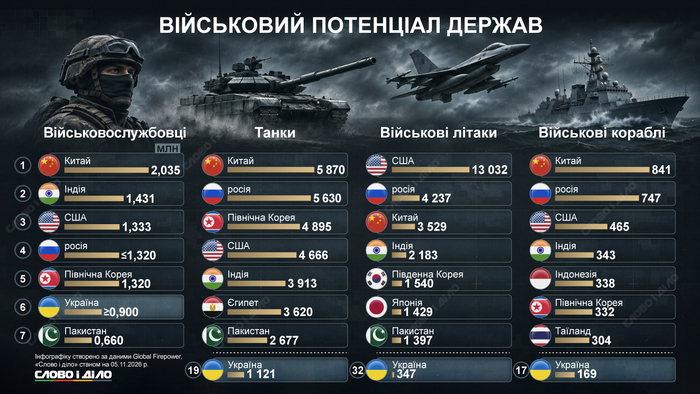
The full-scale war in Ukraine has shown that numerical superiority alone does not guarantee victory on the battlefield. Despite a significant advantage in the number of tanks, aircraft, and warships, Russia was unable to carry out its initial plan to quickly capture Ukraine. At the same time, large stockpiles of weapons and a large number of troops helped the Russian army avoid a large-scale collapse of the front lines. Although comparing military power solely based on the number of vehicles and personnel does not reflect a country’s actual combat capabilities, such indicators remain important even amid the widespread use of drones and modern technologies. This was reported by Dengi.ua, citing an infographic from “Slovo i Dilo.”
Data from Global Firepower allows for an assessment of which countries have the largest armies, the largest tank fleets, and the most powerful air and naval forces. Among the countries featured in the rankings are the United States, China, India, North Korea, Russia, and Ukraine.
Which Countries Have the Largest Armies
According to Global Firepower, China ranks first in terms of the number of active-duty military personnel. Approximately 2,035,000 people serve in the ranks of the People’s Liberation Army (PLA). In addition, more than 600,000 people are part of various paramilitary organizations, including the People’s Armed Police and the People’s Militia.
India ranks second, with its armed forces numbering 1,431,000 active-duty personnel. The country also has numerous paramilitary units under the control of central and regional authorities. In particular, the Central Armed Police Forces number more than 2.5 million personnel.
The United States ranks third, with 1,333,000 active-duty personnel. Global Firepower ranks Russia fourth, with an active-duty force estimated at 1,320,000 personnel. Another 250,000 serve in the Russian National Guard.
North Korea ranks fifth, with approximately 1.3 million active-duty military personnel. This represents about 5% of the country’s total population of 26 million. In addition to its regular army, North Korea has approximately 100,000 personnel in paramilitary units.
Ukraine ranks sixth. According to Global Firepower estimates, the number of its active-duty military personnel exceeds 900,000. Another 100,000 or so belong to paramilitary units. These likely include border guard units and territorial defense forces.
Pakistan ranks seventh, with 660,000 active-duty personnel in its armed forces. In addition, about 500,000 people are part of paramilitary structures, specifically the Civil Armed Forces, which are under the authority of the Ministry of the Interior.
Countries With the Largest Tank Arsenals
China also leads in terms of the number of tanks. It has 5,870 armored vehicles in service. The core of its fleet consists of Type 99A and Type 96A main battle tanks.
Russia ranks second with 5,630 tanks. Despite significant losses of armored vehicles during the war against Ukraine, the Russian army has managed to retain and accumulate a large number of vehicles. Its tank fleet consists primarily of various modifications of the T-72, T-80, and T-90.
North Korea ranks third, with 4,895 tanks. However, according to Global Firepower’s assessment, approximately half of them are combat-ready. The DPRK primarily uses domestically produced armored vehicles, developed in the 1990s based on Soviet designs. Among the main models are the Chonma-ho, Pokpung-ho, and Songun-915.
The United States ranks fourth with 4,666 tanks. The U.S. Army’s main battle tanks are the M1A2 and M1A1 Abrams.
India ranks fifth with 3,913 units. A significant portion of its armored vehicles was developed based on Soviet technology. Specifically, these include the T-90S Bhishma and the T-72 Ajeya, which were produced under license. At the same time, the country also has its own indigenous design - the Arjun tank.
Egypt has the largest tank fleet in Africa, ranking sixth with 3,620 vehicles. Historically, the country relied on Soviet-style weaponry, and T-55 tanks remain in service with its army to this day. However, the United States is currently Cairo’s primary military partner. Consequently, American M1A1 Abrams and M60A3 Patton tanks make up a significant portion of Egypt’s tank fleet.
Pakistan ranks seventh with 2,677 tanks. The country’s main models - the Al-Khalid, Al-Zarrar, and Al-Haider - were developed with Chinese participation or purchased from China. In addition, the Pakistani Army operates T-80UD “Berez” tanks, which were manufactured at the Malyshev Plant in Kharkiv and exported by Ukraine following the collapse of the Soviet Union.
Ukraine ranks 19th in this list, with 1,121 tanks. Most of its equipment is of Soviet origin or was developed after the country gained independence. These include the T-64BV, T-72, and T-80BV. In addition, following the start of the full-scale Russian invasion, the Ukrainian Army received Western tanks such as the Leopard 1 and Leopard 2, the M1A1 Abrams, and the Challenger 2.
The U.S. Maintains Uncontested Leadership in Military Aviation
The United States has the largest aviation fleet among all nations in the world. It has more than 13,000 aircraft of various types at its disposal. This number includes 1,791 fighter jets, 926 attack aircraft and bombers, 917 transport aircraft, and 5,913 helicopters, as well as other types of aircraft.
In terms of the total number of military aircraft, the U.S. lead is so great that the U.S. air fleet exceeds the combined total of Russia, China, India, South Korea, and Japan.
Specifically, Russia has 4,237 aircraft and other flying vehicles, China has 3,529, and India has 2,183. South Korea has 1,540 aircraft, and Japan has 1,429. Pakistan ranks seventh with 1,397 aircraft.
Ukraine ranks 32nd on the list. Its aircraft fleet is estimated at 347 units, including 88 fighter jets, 30 attack aircraft and bombers, 22 transport aircraft, and 140 helicopters. The remainder consists of other types of aircraft.
The World’s Largest Navies in 2026
China ranks first in the world in terms of the number of warships. Its navy comprises 841 vessels. The fleet includes three aircraft carriers, four helicopter carriers, 61 submarines, 46 frigates, and 50 corvettes.
Russia ranks second with 747 ships. However, it has only one aircraft carrier. In terms of total tonnage, the Russian fleet lags significantly behind the Chinese - its total tonnage is less than half that of China’s. The gap with the U.S. Navy is even more substantial. The state of the Russian fleet has also been affected by Ukrainian strikes on naval facilities and ships.
The United States ranks third in terms of fleet size - 465 vessels - but leads in total tonnage. The U.S. Navy has 11 aircraft carriers, nine helicopter carriers, and 66 submarines.
India ranks fourth, with a navy comprising 343 ships. Among them are two aircraft carriers, 18 submarines, and 18 frigates.
Indonesia ranks fifth with 338 vessels. Patrol ships make up the bulk of its fleet. North Korea ranks sixth, with 332 vessels, including 24 submarines. Thailand rounds out the top seven with 304 vessels, the bulk of which are also coast guard ships.
In the Global Firepower ranking, Ukraine ranks 17th in terms of the number of military vessels. Its fleet consists of 169 vessels, predominantly patrol boats. In addition, the Ukrainian Navy includes five minehunters.