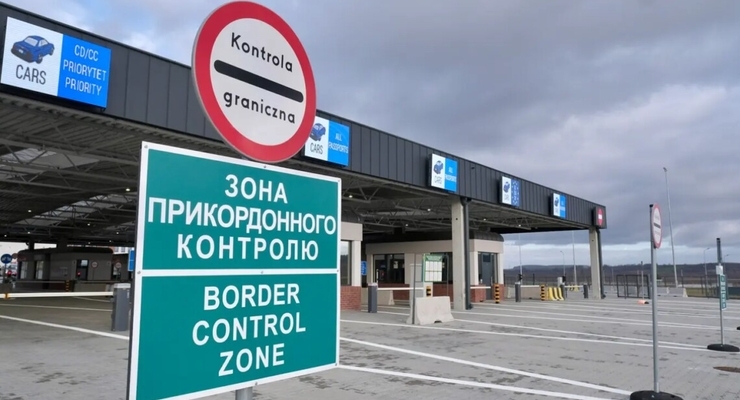
Ukraine is exploring the possibility of relocating border and customs controls to the territory of neighboring European Union countries. This option is being considered as an alternative in case of new Russian attacks on border infrastructure. At the same time, authorities plan to fortify 36 road border crossing points with protective structures. Serhiy Derkach, Deputy Minister for Communities and Territories Development, spoke about this in an interview with RBC-Ukraine, as reported by Dengi.ua.
According to the official, the plan does not involve closing existing checkpoints, but rather establishing joint checkpoints and the possibility of relocating Ukrainian border control services across the border if a security threat arises.
Ukraine Is Negotiating With Poland and Slovakia
Ukraine already has experience with joint border control with neighboring countries. In Poland, four such checkpoints are fully operational, and coordinated control is in place at one additional checkpoint. This means that vehicles are inspected sequentially by the services of both countries.
A fully-fledged system of joint control is in place with Moldova: passengers submit their documents and receive them back after passing inspections by both countries.
However, to further expand this practice, an appropriate legal framework must be established. In particular, Ukraine must conclude separate agreements with the countries on whose territory joint border checkpoints are planned to be established.
According to Derkach, agreements with Poland and Slovakia have already been coordinated at the official level, but the documents have not yet been signed.
The Polish side has submitted the agreement to the European Commission for review. The Commission raised concerns regarding the compliance of two provisions of the document with the Schengen Code. The parties are currently finalizing the wording, after which the agreement can be signed and ratified.
There is no exact timeline for the conclusion of the negotiations yet. Work on the agreements with Poland has been ongoing for several years.
Why Ukraine Needs to Relocate Border Crossing Points
The need for an alternative route for border services stems from Russian attacks on infrastructure near the border.
In the summer of 2026, for the first time since the full-scale war began, strikes were directed specifically at road border crossing points. Among the affected facilities were “Tabaky,” “Vynohradivka,” and “Starokozache” in the Odesa region. Russian attacks also took place near the “Yahodyn–Dorohusk” crossing on the border with Poland.
Previously, the “Orlivka” ferry crossing on the border with Romania had come under attack.
Therefore, Ukrainian authorities are considering relocating their border and customs units to the territory of neighboring countries. This will allow them to continue inspection procedures even in the event of a threat to Ukrainian infrastructure.
At the same time, existing border crossing points will continue to operate as usual unless a threat arises.
Which Countries Are Being Considered for Joint Control
In addition to Poland and Slovakia, Ukraine has sent proposals to Romania and Hungary to conclude relevant agreements. No response has yet been received from these countries.
There is also a plan with Romania to build five new border crossing points on its territory. These intentions were previously formalized in a memorandum.
At the same time, efforts with Poland and Slovakia are currently focused on developing existing border crossing points. Relocating Ukrainian border control services to their territories is viewed primarily as a contingency plan in the event of a real threat.
Will the Lines at the Border Get Shorter?
Joint efforts by border guards and customs officials from both countries within a single territory may slightly reduce the time it takes to clear customs and border control.
However, a significant reduction in lines should not be expected solely from combining inspections.
As Derkach explained, to significantly reduce wait times, the number of border crossing points themselves must be increased. The more border crossing points available, the more options drivers and carriers have for choosing a border-crossing route.
Ukraine’s strategic goal is to build new joint border crossing points within the territory of EU countries. This should increase the border’s throughput capacity and simplify the clearance procedures.
At the same time, Ukrainian border guards and customs officers abroad will be guided by Ukrainian legislation and intergovernmental agreements defining their powers and responsibilities. Such agreements must be ratified by the Verkhovna Rada.
Shelters Will Be Installed at 36 Border Crossing Points
Another area of focus is protecting people who are on border infrastructure sites during air raid alerts and shelling.
According to Derkach, the current need is for 77 mobile shelters. The number required depends on the capacity of each specific facility: for example, if one shelter is designed to hold 25 people, a border crossing point may require several such structures.
There are a total of 41 road border crossing points in Ukraine. Four joint crossing points operate in Poland, and another one is in Moldova. Plans are in place to install stationary or mobile protective structures at the remaining 36.
At checkpoints where construction or renovation is already underway, the shelters are being incorporated directly into the infrastructure projects. For the remaining facilities, mobile structures are being procured.
Authorities expect to install them at most border crossing points—and, if possible, at all of them—by the end of 2026.
Poland has also instructed officials to explore the possibility of equipping shelters at its border crossing points. In Moldova, work is underway to ensure safety during air raid alerts.
Two Pilot Projects Will Be Launched on the Border with Moldova
Separately, Ukraine is preparing two experimental projects that involve relocating existing border crossing points to Moldovan territory.
According to Derkach, the authorities expect Ukrainian and Moldovan services to begin full-scale operations on a single territory by the end of 2026. Currently, these checkpoints operate separately—each on its own side of the border.
In addition, construction is underway on a bridge between the Ukrainian town of Yampil and the Moldovan town of Cosăuți. A new border crossing is planned to open there. The expected completion date is late 2026 or early 2027.
In the long term, Ukraine intends to move away from building large, permanent border complexes in favor of modular structures. Such structures can be set up more quickly and, if necessary, dismantled and reused elsewhere.
The implementation of the strategy for developing border crossing points through 2030 will be financed primarily by Ukraine, but with the support of international aid.
In particular, the European Union will cover 50% of the costs for certain infrastructure projects. These include the expansion of the “Porubne” checkpoint on the border with Romania, the development of the “Luzhanka” checkpoint on the border with Hungary, and the construction of a service area near “Yahodyn.”
In addition, Ukraine is securing funding from the European Investment Bank. According to Derkach, an agreement for 60 million euros to develop border infrastructure was recently signed.