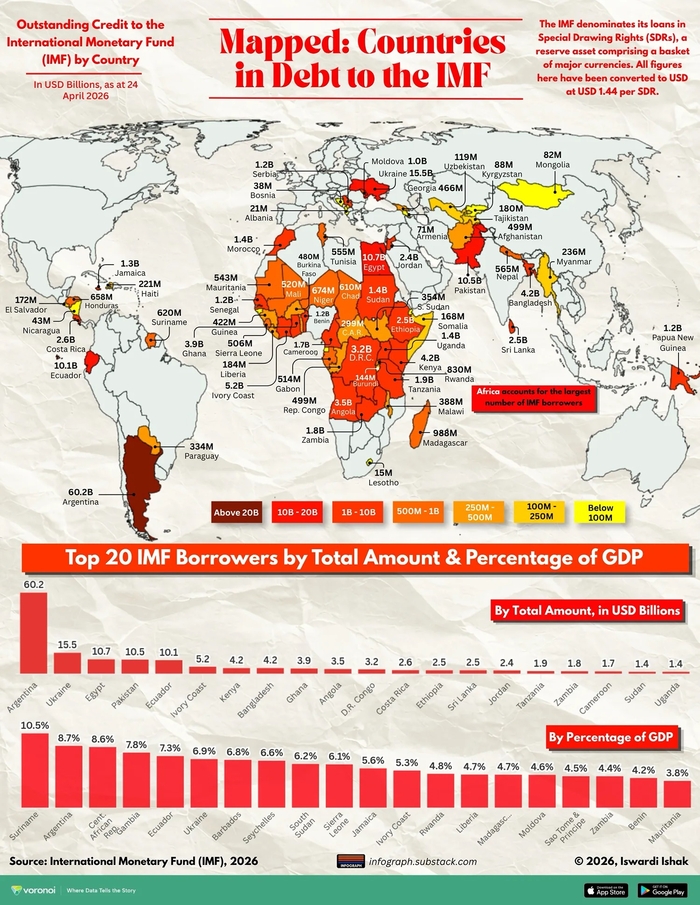
Currently, more than 80 countries carry debt to the IMF. Argentina remains the leader by a significant margin, with a debt exceeding $60 billion. This data, based on IMF figures as of April 2026 and visualized by analyst Iswardi Ishak, highlights the global lending landscape.
Ukraine is the second-largest debtor to the Fund, with an outstanding balance of $15.5 billion, representing 6.9% of its GDP.
Top 10 IMF Debtors in 2026
- Argentina - $60.2 billion (8.7% of GDP);
- Ukraine - $15.5 billion (6.9% of GDP);
- Egypt - $10.7 billion (2.5% of GDP);
- Pakistan - $10.5 billion (2.6% of GDP);
- Ecuador - $10.1 billion (7.3% of GDP);
- Côte d'Ivoire - $5.2 billion (5.3% of GDP);
- Kenya - $4.2 billion (2.9% of GDP);
- Bangladesh - $4.2 billion (0.8% of GDP);
- Ghana - $3.9 billion (3.3% of GDP);
- Angola - $3.5 billion (2.3% of GDP).
Argentina’s debt to the IMF is nearly four times that of Ukraine, the next largest borrower. This disparity reflects decades of inflationary crises, persistent currency instability, and a series of repeated IMF assistance programs.
Why Countries Turn to the IMF
Nations typically seek IMF financing in three specific crisis scenarios:
- Balance of payments crisis: When a country is unable to pay for essential imports or service its existing foreign debt.
- Currency instability: Following a sharp devaluation or the depletion of foreign exchange reserves.
- Fiscal imbalances: Characterized by large budget deficits and rapidly rising public debt levels.
Africa's Systemic Reliance on IMF Support
Africa stands out not due to the size of individual loans, but by the sheer number of debtor nations; the continent has the highest concentration of IMF-supported countries of any region. This is driven by a heavy dependence on raw material exports, limited fiscal capacity, and extreme vulnerability to external shocks. While individual loan amounts are often relatively small, the reliance on IMF support is systemic across the region.
The Mechanics of IMF Debt
Unlike conventional commercial loans, IMF financing is denominated in Special Drawing Rights (SDRs). The SDR is an international reserve asset based on a basket of five major currencies: the US dollar, euro, Chinese yuan, Japanese yen, and British pound sterling. For the purpose of this analysis, data has been converted at an exchange rate of approximately $1.44 per 1 SDR.