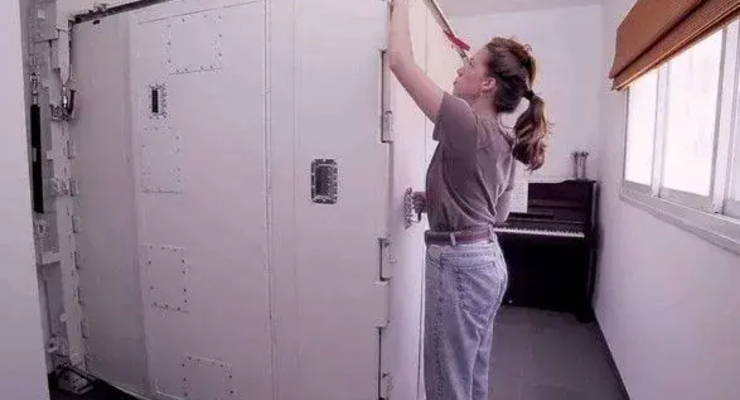
The Ukrainian housing market is gradually beginning to take into account buyers’ new safety requirements. Some developers are considering creating special rooms in apartments, reinforced with reinforced concrete structures, similar to Israeli bomb shelters. However, according to Dengi.ua with reference to RBC-Ukraine, such solutions remain more of an experiment than a widespread standard.
What Is a MAMAD and Why Is It Needed?
According to RBC-Ukraine, the Israeli MAMAD (Merhav Mugan Dirati) is a protected room located directly inside an apartment. In Israel, its construction is a mandatory requirement.
Such rooms are designed to withstand increased loads and are equipped with special protective elements, including reinforced doors and window frames, as well as air filtration systems.
In Ukraine, the term “MAMAD” is currently used more in a general sense. In domestic projects, it typically refers to a separate room measuring about 3–4 square meters with reinforced concrete structures and ventilation.
However, such rooms may not feature a full-fledged air filtration system or bulletproof windows. The main goal is to reduce the risk of injury from glass shards and other debris.
According to Oleksiy Koval, CEO of Perfect Group, as cited by the publication, the company is considering such rooms for one of its pilot projects. Preliminary estimates suggest that the additional cost of such a solution could amount to about 3–4% of the home’s price.
Why Apartment Shelters Are Not Yet Replacing Conventional Ones
The main problem is that Ukrainian building codes do not yet include a legal definition for a "MAMAD" or an "apartment shelter."
As representatives of Kovalska Industrial-Construction Group note, according to RBC-Ukraine, current State Building Norms (DBN) establish requirements for protective structures, shelters, and dual-purpose facilities; however, apartment-based safe rooms are not included in this list.
Therefore, even if a developer provides a reinforced room inside each apartment, this does not exempt them from the requirement to create a shelter for the building’s residents as mandated by the standards.
Olena Ryzhova, Commercial Director of Intergal-Bud, notes that the inclusion of a section on shelters is a mandatory requirement for a new residential project to pass expert evaluation.
In fact, a safety room within an apartment can only be considered an additional level of protection, not an alternative to a regulatory-compliant shelter.
What Can Such a Room Protect Against?
Dmitry Vasilyev, architect and CEO of Archimatika, notes that such rooms serve a practical purpose: they allow people to reach a more secure space more quickly if they are unable to reach the main shelter in time.
In addition, the reinforced structure can reduce the likelihood of injury from the secondary effects of an explosion—such as shards of glass, window frames, facade elements, and finishing materials.
However, such rooms should not be viewed as protection against every type of attack.
As Vasilyev emphasizes, they are not designed to provide guaranteed protection against a direct hit by a heavy missile or a drone warhead, nor do they replace a full-fledged, code-compliant shelter.
Why Such Rooms Have Not Become Widespread
In addition to the absence of a corresponding concept in the State Building Norms (DBN), there is also a structural challenge.
A massive reinforced concrete structure inside an apartment becomes part of the building’s structure. It affects the performance of the entire frame and increases material consumption.
Therefore, as experts note, such solutions are primarily suitable for individual projects in the mid- to high-end price segments.
Furthermore, the presence of such a room limits the possibilities for subsequent remodeling of the apartment or combining the space with other rooms.
What Developers Are Focusing On
Instead of installing individual safe rooms in every apartment, many large developers are focusing on enhancing the overall resilience of residential complexes.
This includes backup power supplies, autonomous heating, private water sources, and the ability to maintain the operation of key utility systems during prolonged power outages.
For example, Intergal-Bud installs rooftop gas boiler rooms and backup power sources for critical infrastructure.
DIM projects include solutions to ensure power for elevators, heating, and water supply during blackouts. Some residential complexes use their own artesian wells.
Another area of focus is improving the resilience of windows and facades. Specifically, the use of protective films on windows is being considered as early as the manufacturing stage.
Are Buyers Willing to Pay Extra?
Buyers’ attitudes toward additional security measures remain mixed.
At Intergal-Bud, they note that customers expect to see a basic level of protection already incorporated into the residential complex's design, while solutions such as special secure rooms or bulletproof windows remain a niche demand for now.
According to Olena Ryzhova, several factors influence the purchasing decision - the building’s location, price, floor plan, infrastructure, the developer’s reputation, installment terms, government programs, and the availability of underground parking.
At the same time, the DIM Group notes increased buyer interest in security. According to a company representative, some clients are willing to pay extra for features that provide additional protection.
In some cases, the absence of such solutions can lead to a buyer walking away from a deal, especially if the property is located in an area that is frequently subjected to shelling.
The demand for protective structures is even more pronounced in private house construction. According to DIM, in approximately 9 out of 10 cases where a client chooses to build a custom house, there is a request to design a private shelter.
What Is Becoming the New Standard
According to RBC-Ukraine, residential “mamads” remain a niche solution in Ukraine for now. Their widespread adoption is hindered by the absence of a corresponding concept in current building codes, their high cost, and their structural complexity.
At the same time, safety is gradually becoming a separate factor in the choice of housing. Developers are emphasizing not only shelters but also a home’s ability to remain functional during emergencies.
Private water sources, backup power for elevators, autonomous boiler rooms, generators, and code-compliant underground shelters are already becoming part of the design of modern residential complexes. For buyers, this means that the issue of safety is gradually moving beyond the scope of a conventional shelter to include the building’s overall self-sufficiency and resilience.