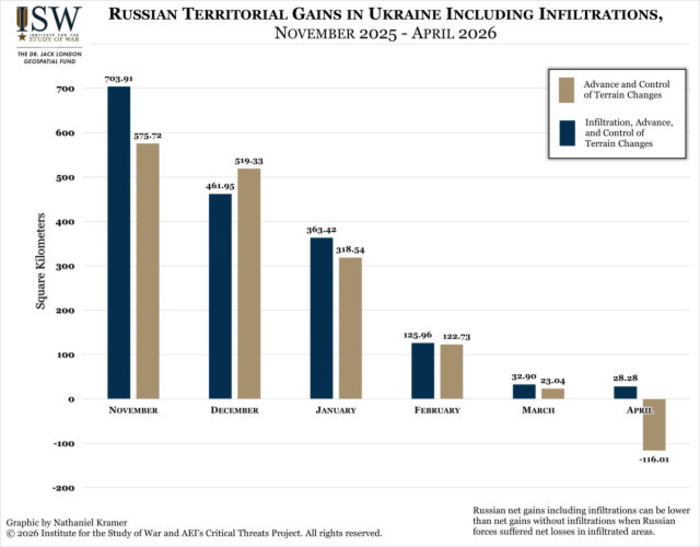
In April 2026, the Russian army recorded a net loss of controlled territory for the first time in two years. According to an assessment by the Institute for the Study of War (ISW), Russia suffered a net loss of 116 square kilometers of territory previously under its control. This shift was reported by Dengi.ua.
Analysts emphasize that these figures only include areas where troops gained a firm foothold, excluding "gray zones" or areas of temporary presence. This is the first such dynamic observed since the Ukrainian operation in the Kursk region began in August 2024.
At the same time, experts note a noticeable slowdown in the pace of the Russian offensive. If at the beginning of 2025 the average advance was about 9.76 square kilometers per day, in the period from January to April 2026, this figure dropped to 2.9 square kilometers. Overall, Russian forces have occupied 1,443.35 square kilometers in the past six months, compared to 2,368.38 square kilometers during the same period a year earlier.
ISW attributes this trend to effective Ukrainian counterattacks and precision strikes, specifically the extensive use of drones. Even pro-Russian sources, such as blogger Mikhail Zvinchuk, have acknowledged that the high density of Ukrainian drones and the reduced size of Russian assault groups make maintaining a high offensive tempo physically impossible.
Russian forces are facing intensified command-and-control challenges following the loss of Starlink terminal access and the blocking of the Telegram messaging platform. Environmental factors have also played a role: the 2025–2026 winter was colder and wetter than the previous year, leading to a more severe muddy season, where melting snow and rain turn the terrain into impassable mud for heavy equipment.
Since the fall of 2025, the Russian military has increasingly relied on "small-unit infiltration" into gray zones without establishing full control. ISW suggests these tactics may be used to create an illusion of progress for reporting to the Kremlin, even as the territories remain disputed and under constant fire from both sides.
In April 2026, Russian forces managed to advance in or consolidate only 28.28 square kilometers. While they have moved into 1,716.42 square kilometers over the past six months, the territory they actually hold is estimated at only 1,443.35 square kilometers.