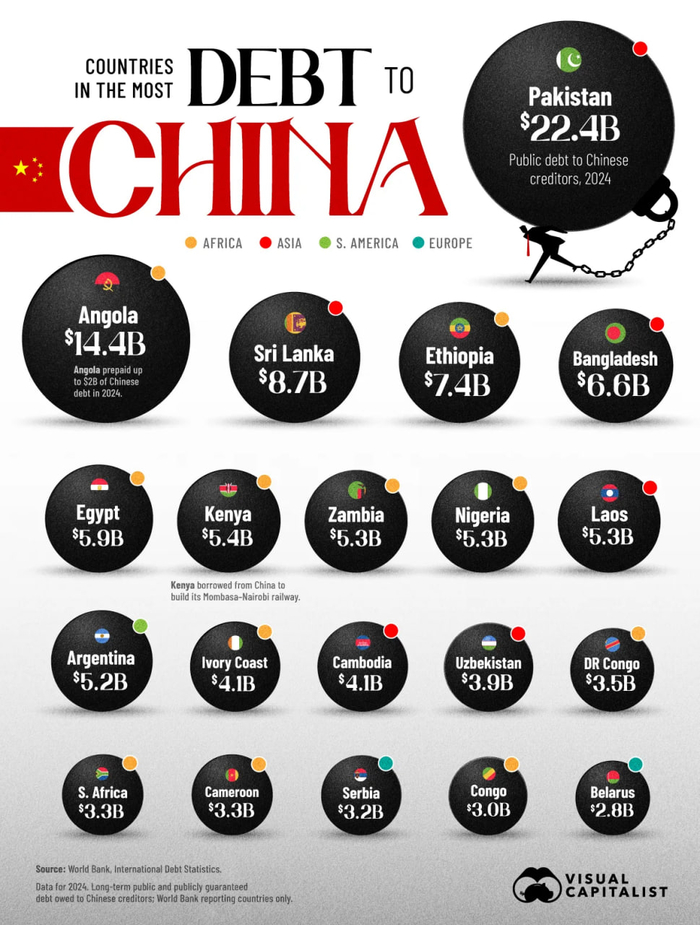
Pakistan ranks first among countries with the largest outstanding debt to Chinese creditors. It totals $22.38 billion—nearly $8 billion more than Angola, which ranks second. This was reported by Dengi.ua, citing an infographic from visualcapitalist.com.
For many decades, Islamabad has maintained close military and economic cooperation with Beijing. Both countries describe their relationship as an “all-weather strategic partnership.” Chinese loans have enabled Pakistan to carry out large-scale projects in the energy and transportation infrastructure sectors.
Angola owes Chinese creditors $14.4 billion. Cooperation in this area intensified after the end of the civil war, when the country received a $2 billion credit line in 2004. As the economy and infrastructure recovered, the volume of Chinese financing continued to increase.
Kenya, whose debt to China has reached $5.37 billion, serves as an example of the practical use of such funds. Chinese loans covered about 90% of the construction costs for the railroad connecting Mombasa and Nairobi. The railway linked the capital to the country’s largest seaport and created a route for passenger and freight transport.
Chinese lending benefits not only the borrowing countries but also companies from the PRC. Chinese contractors participated in the construction of the railway in Kenya and the Addis Ababa–Djibouti line. In addition, Chinese firms supplied the necessary equipment and participated in the operation of these facilities. As a result, financing for overseas infrastructure projects supports demand for Chinese engineering services and technologies.
The China-Pakistan Economic Corridor Is Transforming the Country’s Infrastructure
One of the largest areas of Chinese investment has been the China-Pakistan Economic Corridor (CPEC). It includes the construction of power plants, power transmission lines, and transportation facilities. These projects aim to reduce the electricity shortage and improve transportation accessibility in various regions of Pakistan. Investments in the energy sector include coal-fired, hydroelectric, wind, and solar power plants.
By the end of 2024, the facilities commissioned as part of the corridor had increased the capacity of Pakistan’s power grid by more than 8,900 megawatts. In addition, nearly 900 kilometers of highways and expressways were built in the country. This infrastructure development has expanded opportunities for supplying electricity to households and businesses, as well as for transporting goods within the country.
Financial cooperation between Beijing and Islamabad involves not only the provision of new loans but also the negotiation of repayment terms for previously issued loans. In March 2025, China extended the repayment deadline for a $2 billion loan to Pakistan by one year. The decision allowed Islamabad to defer a large payment while it continued to implement a broader economic stabilization program.
Does Chinese Lending Lead to Debt Dependency?
Significant obligations to Chinese creditors are heightening concerns about the ability of certain countries to service their debts on time. In particular, the Republic of the Congo’s debt stands at $2.97 billion. In nominal terms, this amount exceeds one-tenth of the country’s annual economic output.
China’s lending practices have also been criticized under the concept of “debt trap diplomacy.” According to this interpretation, large-scale infrastructure financing can increase the financial dependence of borrowing countries and provide Beijing with additional levers of strategic influence.
One of the most frequently cited examples in such discussions is Sri Lanka, which owes $8.69 billion to Chinese creditors. The Hambantota port project is at the center of attention. However, the notion that China’s lending policy is driven solely by a desire to create debt dependency remains a matter of debate.
Researchers also point to the domestic economic problems of borrowing countries and other factors affecting their ability to service their debts.
At the same time, some countries are gradually reducing their debt to Beijing. For example, Angola’s debt decreased by nearly one-fifth between 2023 and 2024. However, the country’s ability to make further early loan repayments depends largely on the situation in the global oil market and oil price trends.
Top 10 Countries Owing Debt to China
- Pakistan 22.38 billion
- Angola 14.40 billion
- Sri Lanka 8.69 billion
- Ethiopia 7.44 billion
- Bangladesh 6.63 billion
- Egypt 5.91 billion
- Kenya 5.37 billion
- Zambia 5.33 billion
- Nigeria 5.32 billion
- Laos 5.31 billion