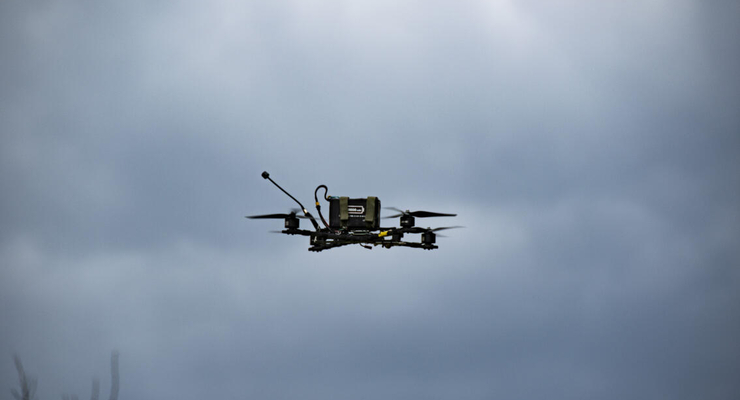
The expansion of the operational range of Ukrainian drones attacking targets deep behind the frontlines of the Russian army is creating severe problems for the logistics and supply of Russian troops in the Zaporizhzhia and Kherson regions, as well as in the Donbas. These logistical difficulties are being reported by Russian pro-war "Z-correspondents" and military analysts alike. This is reported by Dengi.ua with reference to The Moscow Times.
According to them, low-cost Ukrainian drones capable of striking targets at distances of up to 150 kilometers have effectively turned the R-280 "Novorossiya" highway - which connects Russia to occupied Crimea via the so-called "land bridge" - into a perilous route. Commercial truck traffic has been restricted on this road since last week. The pro-war Telegram channel "PriZrak Novorossii" also writes about the critical situation in Donetsk, where in recent months the AFU has regularly targeted thermal power plants, warehouses, and locations of Russian units.
"Those areas of Donetsk and the 'DPR' that were considered relatively safe have no longer been so for several months. We are already talking about precision strikes to the full depth of Donetsk and Makiivka," the channel notes.
Attacks on logistics infrastructure have also heavily impacted areas near the Sea of Azov. According to the OSINT project "Oko Gora," more than 60 cargo trucks have been destroyed on the M-14 and H-20 highways over the past three weeks. The Rybar Telegram channel claims that the situation is becoming increasingly tense in the Kherson and Zaporizhzhia regions, describing logistics as already "partially paralyzed." It notes that Ukrainian forces have significantly increased the frequency of strikes on vehicles, while in Crimea, this has sparked fears of impending shortages of certain goods, triggering restrictions on fuel sales.
At the same time, Rybar emphasizes that the issue extends far beyond disruptions to the tourist season.
"Strikes on cargo carriers on the peninsula directly affect the combat capabilities of the Russian Armed Forces on the southern fronts, where the situation is already far from clear," the channel writes.
Military analyst Ian Matveev believes that supply lines along the 480-kilometer section of the front where the Russian "Dnipro" and "Vostok" groupings operate are under imminent threat. He noted that these supply disruptions will also heavily impact Russian drone units, given that the UAVs themselves are delivered to the frontline by the thousands every day via cargo transport.
"At least 150,000 people risk being left practically without supplies," Matveev believes.
He estimates that this applies to units deployed from Pokrovsk to Kamianske, as well as territories along the Dnipro River down to the Kinburn Spit, including rear areas in Vuhledar, Melitopol, and Nova Kakhovka.
The "PriZrak Novorossii" channel claims that these trends became noticeable as early as late last year. The frontline is advancing much slower as the Ukrainian military expands and deepens the zone of active, precision UAV strikes into the Russian rear.
The channel's authors warn that problems with logistics and troop deployment could become critical in the coming months, complaining that the situation has not yet received adequate attention at the highest levels of government.
Matveev calls the current developments a "turning point in the war." He notes that while strikes on logistics lines were previously carried out within 10 to 20 kilometers of the frontline, they are now occurring at distances of up to 150 kilometers.
"That area is where the major logistical arteries are, where big trucks with supplies and huge gasoline tankers travel. At this stage, the cargoes are not yet decentralized; they are delivered in a concentrated manner, and each attack, each destroyed trailer, causes more substantial damage," the expert explains.
Analysts at the US-based Institute for the Study of War (ISW) also believe that successful medium-range Ukrainian drone strikes are making it increasingly difficult for Russia to rotate personnel and hold its positions. The ISW estimates that in April, the Russian army saw a net reduction in its controlled territory for the first time since 2024, with losses amounting to 116 square kilometers. The institute's experts believe that even a potential new mobilization will not guarantee a turnaround if the Russian side remains unable to effectively counter UAV attacks.
At the same time, Matveev notes that the destruction of logistics alone does not guarantee success on the battlefield without follow-up infantry maneuvers. However, he believes that if Ukrainian forces continue to mount pressure, the Dnipro and Vostok groupings could face a severe supply crisis in the coming months.
"Heavy losses of Russian troops persist, and the recruitment rate is not increasing. There is a general qualitative degradation of the army; professionalism and motivation are falling lower and lower. The prognosis for the Russian military is extremely bleak," the expert concluded.