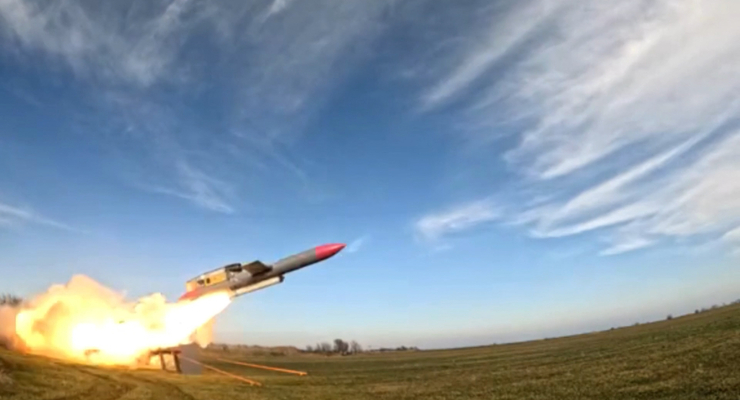
Ukraine’s “Flamingo” long-range missiles have deprived Russia of a secure deep rear, enabling the high-precision destruction of fortified military-industrial complex facilities at long ranges. This was stated by Iryna Terekh, CEO of the defense company FirePoint, during the Euronews Defense and Space Summit in Brussels, as reported by Dengi.ua.
How Long-Range Missiles Strike Factories Deep Inside Russia
The weapons were specifically designed to penetrate and destroy heavily fortified infrastructure, particularly Soviet-style reinforced concrete industrial facilities located far from the front lines. The missiles have already proven their effectiveness in real combat operations on the territory of the aggressor state.
According to the developers, one of the most telling results of their combat use was:
- inflicting critical damage on the enemy’s space industry facilities;
- disrupting and significantly interfering with the implementation of Russia’s “Dawn” space program;
- enforcing “kinetic sanctions” that physically halt the enemy’s military-industrial production chains;
- completely eliminating the concept of a secure deep rear for the Russian military command.
Why Ukraine Is Scaling Up “Flamingo” Production to Thousands of Units
The manufacturer laid the groundwork for rapid, mass production as early as the weapon’s design phase. In the context of a protracted war and technological confrontation, a limited number of high-precision weapons is insufficient to turn the tide of combat operations.
Key factors in expanding production capacity:
- mass production: the missile’s design is optimized for serial production on a scale of thousands of units per year;
- a shift in the supply paradigm: moving away from producing just 600–700 units of long-range weapons per year, as this is insufficient for a large-scale war;
- combined production: simultaneous expansion of assembly lines for both strike drones and missile systems;
- autonomous strike capability: ensuring consistent fire control over key nodes of Russia’s military machine without dependence on foreign restrictions.
Iryna Terekh emphasized that manufacturing thousands of long-range weapons is an absolute necessity, as geopolitical threats will only intensify in the future.