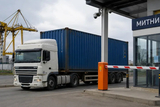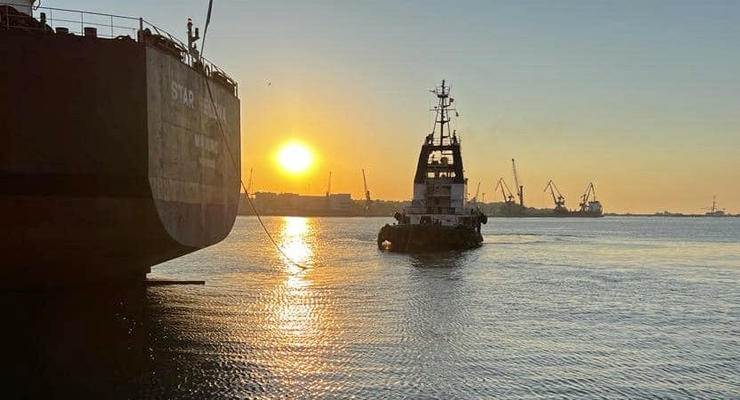
Exports of Ukrainian agricultural products through the ports of Greater Odesa have effectively come to a halt, so the bulk of shipments now has to be rerouted via land and river routes. However, their capacity is insufficient to fully meet Ukraine’s export needs, and further increases in volume may prove economically unfeasible. This was stated by Minister of Agrarian Policy Taras Vysotsky in an interview with Novyni.LIVE, as reported by Dengi.ua.
Maritime Shipments Have Virtually Ceased
According to Taras Vysotsky, there are currently no significant new export volumes passing through the ports of Greater Odesa.
A few ships were able to leave the ports after previous calls, but there are virtually no new maritime shipments.
“As of today, there are virtually no exports from the ports of Greater Odesa. A few ships that had remained there following previous port calls have since departed,” said Taras Vysotsky.
As the minister noted, since August, Ukrainian exports have been gradually shifting to other destinations.
These include rail transport via land border crossings, a river route along the Danube to Constanta, Romania, with subsequent shipment of goods by sea, as well as road transport.
However, the capacity of road transport remains limited.
“The share of road transport is insignificant - 5-7 percent - and it is difficult to expand it for major grain crops because, after all, economies of scale are necessary there,” Vysotsky noted.
Rail and the Danube Handle the Bulk of the Volume
Currently, the greatest burden falls on rail transport and the Danube corridor. Each of these routes accounts for more than 45% of exports, while road transport accounts for only 5–7%.
At the same time, Ukraine needs to export approximately 5 million metric tons of agricultural products per month, or about 60 million metric tons per year.
In August, nearly 1.7 million metric tons of products were successfully exported via alternative routes. This amounted to about 33% of the baseline monthly requirement.
In September, the situation improved somewhat.
“As of today, if we look at the first 20 days of September, we have reached 44% of the baseline requirement. Volumes are improving,” the minister said.
It Will be Difficult to Export More Than Half of the Required Volume
According to expert estimates, alternative routes theoretically allow exports to be increased to approximately 50% of Ukraine’s baseline demand.
However, it will be difficult to significantly exceed this figure.
“It will be very difficult to increase exports further, and at times it will simply be so expensive that it won’t make economic sense,” Vysotsky emphasized.
Thus, even with maximum utilization of rail and river routes, it will be problematic to completely replace maritime logistics. This is especially true for bulk grain shipments, for which the cost of transporting each metric ton is of great importance.
What Will Happen to Maritime Exports
The future of exports largely depends on the ability to safely resume maritime transport through the ports of Greater Odesa.
According to Novyni.LIVE, Ukraine is continuing negotiations with countries that rely heavily on Ukrainian food supplies. Among them, Vysotsky named Turkey, Egypt, Algeria, the Gulf States, and India.
The goal is to find solutions that would ensure the safe operation of the maritime export route.
However, no specific agreements have been reached yet.
“At this point, we cannot confirm that any specific agreements have been reached,” the minister noted.
According to Vysotsky, the negotiation process is ongoing, including on the sidelines of the UN General Assembly. The minister expressed hope that some news on this issue might emerge as early as the beginning of October.
For now, however, Ukrainian exporters have to rely primarily on alternative routes, which are limited both technically and economically.