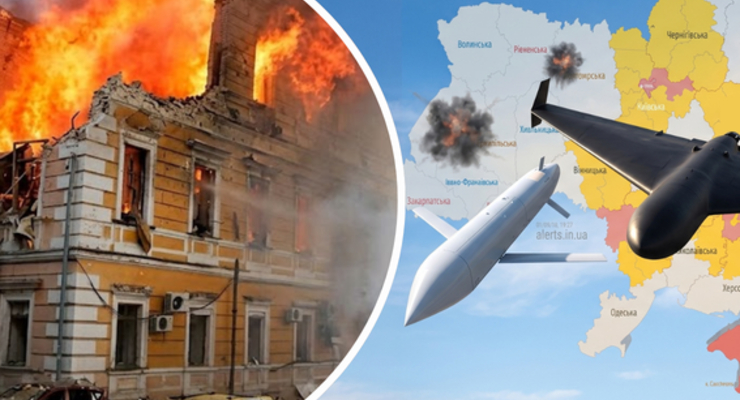
According to monitoring Telegram channels, airstrikes on Kyiv lasted 18 hours and 43 minutes on September 27. Throughout the day, jet-powered drones struck, among other targets, residential buildings, schools, data centers, and warehouses. Over the past month, a significant portion of the country has effectively turned into a frontline region due to round-the-clock attacks by high-speed UAVs and inexpensive cruise missiles. Ukrainians are concerned about one question: how and when will air defense forces stop this drone onslaught?
The Evolution of the Drone Threat
Russia began developing the concept of jet-powered drones as early as 2023. According to an analysis of leaked enemy documents conducted by “Military,” in April of that year, a high-speed MS-237 UAV was demonstrated to a Russian delegation in Iran, and Moscow was already developing plans to localize its production. Later, in late November 2023, Iran officially unveiled the Shahed-238, equipped with a turbojet engine.
A few months later, in January 2024, one of the first high-speed drones was shot down in Ukrainian airspace. The fact that production was not on a large scale at that time is evidenced by the fact that in February 2024, at an exhibition in Saudi Arabia, Russia sought to sell its own jet-powered Shahed variant for a sky-high price of $1.4 million, thereby ruling out the idea of a cheap weapon.
Analysts at Defense Express speculated that the Russian Federation continued to experiment with high-speed drones throughout 2024. As a result, in February 2025, Ukraine's Defense Intelligence (GUR) reported that Russia was establishing production of a Shahed-238 variant called the “Geran-3.” As early as the spring of that same year, ISW analysts noted that the enemy had begun to use jet-powered drones more actively. Later, in June, there were alleged signs of an attempt to strike Kyiv with a “Geran-3,” although the military and the Ministry of Internal Affairs confirmed the first such attack on the capital in late July.
In September 2025, Defence Intelligence of Ukraine (GUR) released the specifications for the “Geran-3”: a Chinese Telefly JT80 engine, a range of up to 1,000 km, and a speed of 300–370 km/h. According to publicly available data, the UAV may cost at least $80,000. As a result, air defense forces recorded at least 180 instances of jet-powered drones being used throughout 2025.
However, in August 2026, Defense Intelligence (GUR) reported that Russia had halted production of the “Geran-3.” Among the reasons cited by Defense Express analysts was its cruising speed of 280–330 km/h, which made it vulnerable to destruction by anti-aircraft interceptor drones. Furthermore, according to intelligence reports, the “Geran-3” was merely a transitional model leading to the more advanced and faster “Geran-4.”
The first mentions of this model appeared as early as January 2026, when one was shot down using a Soviet R-60 air-to-air missile. Subsequently, Defence Intelligence noted that, starting in May 2026, the enemy began actively deploying the new “Geran-4.” The agency reported that the drone features a reinforced aerodynamic airframe with fixed wings, capable of flying at altitudes of up to 5 km at speeds of up to 500 km/h and covering distances of up to 450 km. In addition, there is a “Geran-4 Seeker” variant equipped with an optical guidance system that is controlled in real time and capable of automatically acquiring targets at a range of 5–10 km.
On the other hand, in early January 2026, Defence Intelligence (GUR) reported that Russia had attacked Ukraine for the first time using the “Geran-5,” which is structurally similar to the Iranian Karrar and technologically akin to a cruise missile. It is equipped with a Chinese Telefly TF-TJ2000A engine, which allows it to travel up to 950 km at a speed of 450–600 km/h at an altitude of at least 6 km. In May, Defence Intelligence (GUR) warned that Russia had already begun mass production of the “Geran-4” and “Geran-5” (according to open-source data, the fourth model costs up to $200,000, and the fifth, up to $150,000).
As of early June, Russia had launched approximately 1,400 jet drones toward Ukraine, according to the publication "Militarnyi." At the same time, in June, according to the Air Force (AFU), the number of high-speed “Geran-3/4/5” drones launched was 350; in July, according to Serhiy Beskrestnov (“Flash”), the number had already reached 1,500, and in August, according to Air Force data, at least 2,850. According to President Volodymyr Zelenskyy, Russia used more than 2,730 such drones in September. Sources at RBC-Ukraine reported that by November, Russia plans to ramp up production and increase the share of jet-powered drones in its attacks to 80%.
New, Cheap “Winged Missiles”
The protracted and costly war has forced Russia to find a cheap means of waging missile terror against Ukraine in the form of the S8000 “Banderole” loitering munition with a jet engine, also known as a small-sized cruise missile.According to Defence Intelligence (GUR), it is equipped with a Chinese Swiwin SW800Pro engine and carries a 150-kg warhead up to 500 km away at a speed of 500 km/h. According to open-source data, the “Banderole” may cost $150,000–300,000.
As early as 2024, the adversary conducted test launches of this weapon; in April 2025, the attacks intensified, and they became systematic starting in May 2026. In July 2026, Defence Intelligence (GUR) noted that Russia had completed testing of the “Banderole” and moved to mass production - about 80 units per month.
In addition, Russia has the “Dan-T” cruise missile, which it first demonstrated in early September at a defense exhibition in Egypt. Its warhead weighs 130 kg, it has a range of up to 450 km, and a speed of up to 500 km/h. According to daily reports from the Air Force, since September 13, the “Dan-T” has frequently appeared among the Russian Federation’s air attack capabilities. Sources at RBC-Ukraine reported that Moscow plans to produce up to 2,000 such missiles by the end of the year and another 14,000 in 2027. At the same time, Taba.Briefings noted that Russia plans to gradually phase out the “Banderole” in favor of the “Dan-T,” as the latter is approximately 35% cheaper.
The Scale of Jet-Powered Terror
A new daily terror campaign involving rocket drones and cheap missiles has changed the nature of air attacks and increased the burden on air defense systems. Currently, according to Yuriy Ignat, the effectiveness of shooting down rocket drones has reached 60%. Reuters noted that since Russia began actively using such weapons, hundreds of them have struck Kyiv and other Ukrainian cities, disrupting businesses, government agencies, and daily life on a much larger scale than during the previous 4.5 years of the major war.
Jet drones have already struck postal infrastructure—in particular, the “Nova Poshta” sorting center in Zaporizhzhia and a terminal in the Odesa region—and have hit Rozetka warehouses, McDonald’s in Kyiv, and “Epicenter” hypermarkets in Kharkiv and Mykolaiv. As Politico reported, Russia is increasingly attacking passenger trains with jet drones, causing “Ukrzaliznytsia” to lose 37–40 locomotives every month. In addition, these UAVs carried out at least 7 strikes on gas stations in the capital and 6 on data centers. The Guardian noted that since late August, Kyiv has effectively turned into a frontline city.
Prime Minister Serhiy Koretsky emphasized that at least 288 people were killed by jet drone and missile strikes during the first three weeks of September. Moreover, the geographical scope of the strikes is no longer limited to the central and southern regions. In late August, OSINT analysts recorded a jet-powered UAV launched from Crimea traveling 960 kilometers to western Ukraine.
In a comment to Dengi.ua, military expert and founder of the “Reactive Post” charitable organization, Pavlo Narozhnyy, noted that such long-range flights occur due to a lack of radar systems capable of continuously tracking the targets’ routes.
“We need a large number of radars to track the flight paths of jet drones across Ukraine in real time. Right now, they can fly into, say, the Sumy region, but strike in the Odesa or Lviv regions,” he emphasized.
Aviation expert and leading researcher at the National Aviation University Valerii Romanenko also added in a comment to Dengi.ua that jet drones are sometimes deliberately launched at altitudes of about 7 km, where they can only be intercepted by certain anti-aircraft systems, specifically the Aster, AMRAAM, S-300, and MIM-104 Patriot. However, the expert noted that wasting scarce missiles on drones with a 50-kilogram warhead is simply irrational, since they are needed to destroy missiles carrying more than 450 kg of explosives. According to him, this altitude is safe for fighter jets; however, if the jets are not in the air, the drones can break through, and they will then be shot down over the city.
As for the “Banderole” drones, the National Security and Defense Council noted that more than 80% of missiles are shot down over Kyiv. However, other regions are suffering significantly from them. In particular, in the summer of 2026, “Banderole” missiles accounted for about 80% of Russian strikes on Odesa’s food infrastructure. At the same time, in Kharkiv, this type of munition destroyed a five-story building, and in Dnipro, it struck the “Karavan” shopping center.
How to Shoot Down Jet-Powered Drones
Pavlo Narozhnyy noted that the jet-powered Shahed is a completely new type of weapon, so at this time there is no ideal countermeasure against it among the available systems.
“All these solutions, all these air defense systems, were developed to counter cruise missiles, which are expensive and produced in limited quantities by the enemy. But the Russians have essentially cracked the system, since they may now have up to 10,000 jet-powered drones, whereas their stockpiles of air defense missiles or air-to-air missiles certainly do not exceed that number,” he emphasizes.
Aviation expert and co-founder of Defense Hub, Bohdan Dolintse, noted in a comment to Dengi.ua that high-speed drones are currently neutralizing air defense systems such as the IRIS-T and NASAMS, Stinger and Strela man-portable air defense systems (for targets at altitudes up to 2 km), as well as AIM-9, AIM-120, and R-73 air-to-air missiles. The most expensive method involves the use of ground-based air defense systems, where a single missile can cost anywhere from $150,000 to $1 million.
According to the expert, F-16 and MiG-29 aircraft use large-caliber cannons, with each round costing about $10–20; however, this low cost is offset by the cost per flight hour, which runs $30,000–40,000. However, Dolintse pointed out another comparable or even cheaper solution—old Hydra 70 unguided rockets, upgraded with the APKWS laser guidance system, which makes them guided. The cost of a single launch is estimated at $3,000–5,000, and the range for engaging targets reaches 5–7 km.
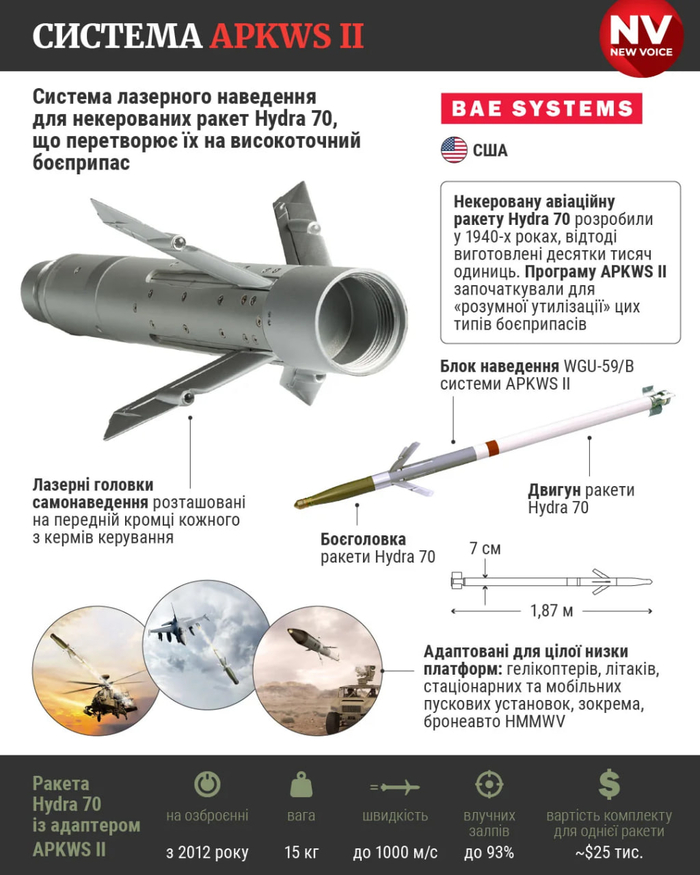
Valerii Romanenko added that although a fighter jet can carry two pods, each holding 19 such missiles, the service life of the aircraft transferred to Ukraine—which are already 40 years old—is significantly limited, so it is not rational to deploy aircraft just to intercept one or two drones.
“We’ll simply exhaust their service life, and in 3–4 months we won’t have anything left to send into the sky. And when a massive air raid occurs, most fighter jets take to the air,” the expert explains.
Romanenko also noted that although high-speed interceptor drones are currently being developed, there aren’t enough engines for them. However, he said, a more promising approach might be to use existing electric drones equipped with rocket boosters and compact radar. Such drones could be launched to the required altitude, after which a radar with a range of about 1 km would detect a Russian jet drone and guide the interceptor toward it—not in pursuit, but head-on—similar to an anti-aircraft missile. According to the expert’s estimate, the cost of such a radar is about $4,000.
At the same time, Romanenko proposed equipping mobile fire teams with RPS 202-type radars. Upon receiving the drone’s coordinates and direction of travel, the unit can take up a position in advance and prepare to intercept it using a MANPADS or an interceptor drone.
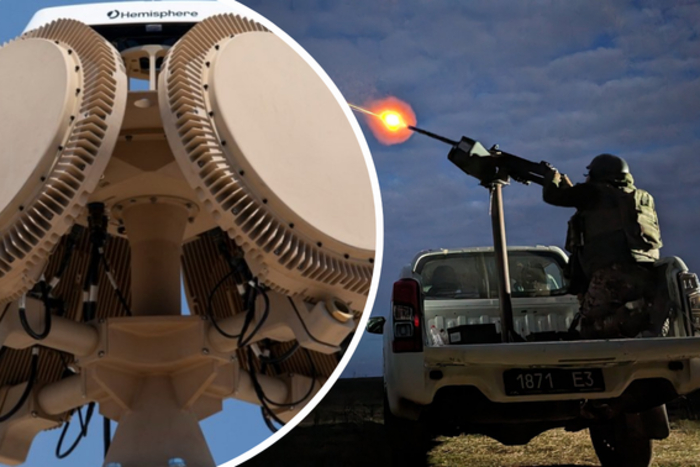
For his part, Bohdan Dolintse noted that high-speed interceptor drones currently have little impact on shooting down “suicide drones,” but their numbers and effectiveness will increase in the next 2–6 months. In his view, one of the most important alternatives is the development of domestic solid-fuel interceptors—inexpensive surface-to-air or air-to-air missiles costing up to several thousand dollars.
“We’re talking not only about intercepting jet-powered drones, but also mass-produced cruise missiles such as the ‘Bandero’l’ and ‘Dan-T.’ Moreover, very soon we will see target speeds increase to 900–1,000 km/h, so there will be a need for mass-produced, inexpensive solid-fuel interceptors that must be at least 10–20% faster. In fact, we’re talking about creating a Ukrainian counterpart to Israel’s “Iron Dome,” the expert explains.
According to Dolintse, the development of such systems typically takes 2–6 years or more. However, Ukraine already has relevant experience and companies that have developed solid-fuel boosters, in particular for long-range strike UAVs, so in reality, we could be talking about a matter of months or a single year.
“The cost of ‘Iron Dome’-type systems is quite high. The cost can reach hundreds of millions of dollars. Whether Ukraine will be able to do this faster, cheaper, and more effectively remains to be seen. Even with existing technical foundations, such a development will require at least tens of millions of dollars,” Dolintse asserts.
For his part, Pavlo Narozhnyy noted that scaling up production of its own anti-aircraft missiles will be difficult, if only because Ukraine does not manufacture homing warheads.
Thus, it must be acknowledged that, in the fifth year of the war, Russia has succeeded in creating a weapon of mass terror used daily against businesses and the civilian population. Ukrainians are adapting to a new reality, where a yellow alert level plunges the rear into conditions akin to those of frontline zones—life goes on amid the constant hum of jet drones and cruise missiles in the sky. We could debate at length who is to blame for the fact that the Russian Federation has managed to impose these conditions, but now we need to focus on solving the current problem and developing defenses against future aerial escalation.